



In the more than 10 years since Angola, Botswana, Namibia, Zambia, and Zimbabwe signed a 2011 treaty to create the Kavango Zambezi (KAZA) Transfrontier Conservation Area – the world’s largest transboundary terrestrial conservation area – much has been accomplished. Much also remains to be done.
The 2022 KAZA Elephant Survey was a remarkable achievement. It was the first time that Africa’s largest savanna elephant population was surveyed in a fully coordinated and synchronized manner, setting a new benchmark for aerial surveys for which the KAZA Secretariat and partner states deserve much praise; this was truly a major milestone in collaborative management of a globally unique wildlife resource.
KAZA’s elephant population was estimated to be 227,900 (±95% CL 16,743), representing the majority of what’s left of Africa’s elephants. The survey also noted relatively high carcass ratios suggestive of elevated mortality, warranting further investigation as a potential warning sign for the health and stability of this globally important elephant population. Quantifying a wildlife population like this (and understanding its distribution in both space and time) is necessary to inform its management. But counting does not automatically lead to positive conservation outcomes.
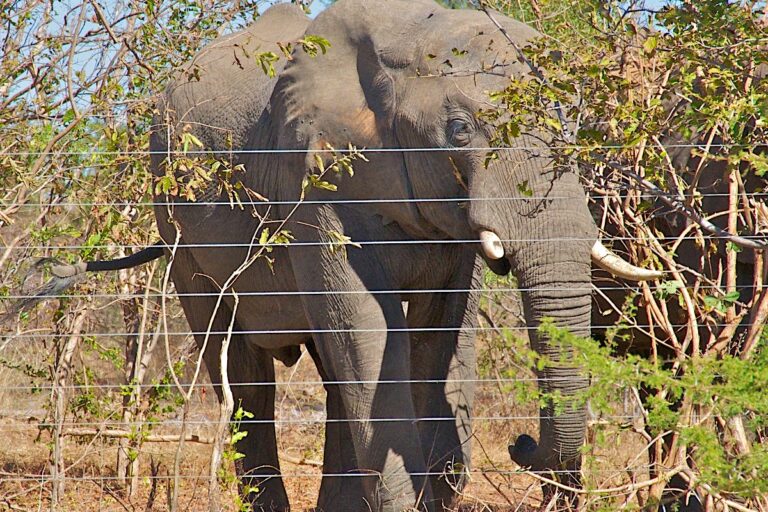
Many refer to KAZA’s elephants as a metapopulation, as one contiguous group of animals. But that characterization is increasingly misleading, as visible habitat fragmentation continues to take its toll. The habitat corridors that elephants and other species need to access water, food, minerals, and breeding opportunities across the vast KAZA landscape at different times of year are being increasingly blocked by expanding human settlements and activities like agriculture, as well as by linear infrastructure including roads and veterinary cordon fencing.
The recently published KAZA elephant policy brief — in its own right a groundbreaking, multi-year collaborative effort involving dozens of governmental and nongovernmental institutions across KAZA — provides multiple recommendations on how connectivity among KAZA’s elephants might be achieved. Foremost amongst these is addressing veterinary cordon fencing, the erection of which began in the late 1950s to separate livestock from wildlife due to animal disease concerns. These fences are demonstrably obstructing critical elephant movements, and we urge the KAZA partner states to take advantage of new, internationally approved approaches for managing beef production that no longer depend upon the separation of livestock from wildlife with vast, environmentally damaging fences.
In 2011, Angola, Botswana, Namibia, Zambia, and Zimbabwe made an ambitious commitment to create KAZA and harness conservation as a regional economic driver, to sustainably benefit communities and governments alike. Now that KAZA’s elephants have been counted, the landscape’s key wildlife areas must be connected, so that elephants and other species can be better conserved. A regional revisiting of veterinary fencing policy, with its roots in European colonial rule and as perpetuated to this day by European countries importing southern African beef, is overdue. A collective investment in earnest stewardship of natural resources, including wildlife as well as grazing lands of critical importance to wild and domestic animals, must thus be made by all sectoral stakeholders dependent on southern Africa’s precious land-base.
There is now, for the first time in several generations, an opportunity to find ways to optimize land-use choices in the interest of system resilience and diversified livelihood opportunities. Neither the livestock nor wildlife sectors should seek to dominate the other. Instead, it is time to make land-use decisions that will be socially, ecologically and economically sustainable for generations to come.